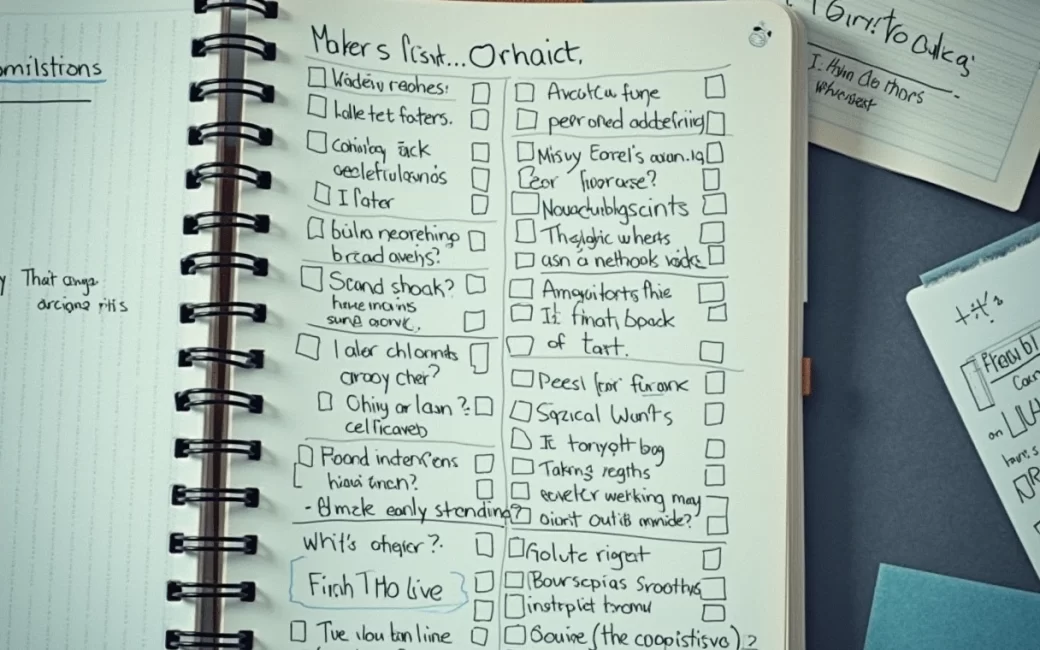
Unclear priorities across a long task list
A list of forty items tells you nothing about which one to do next. That's the actual failure mode behind "poor prioritization": not too few tasks, but no rule for ordering them, so the reader picks by whatever feels most urgent in the moment — usually a Slack message or an email — while the task that actually matters sits untouched until the deadline forces it.
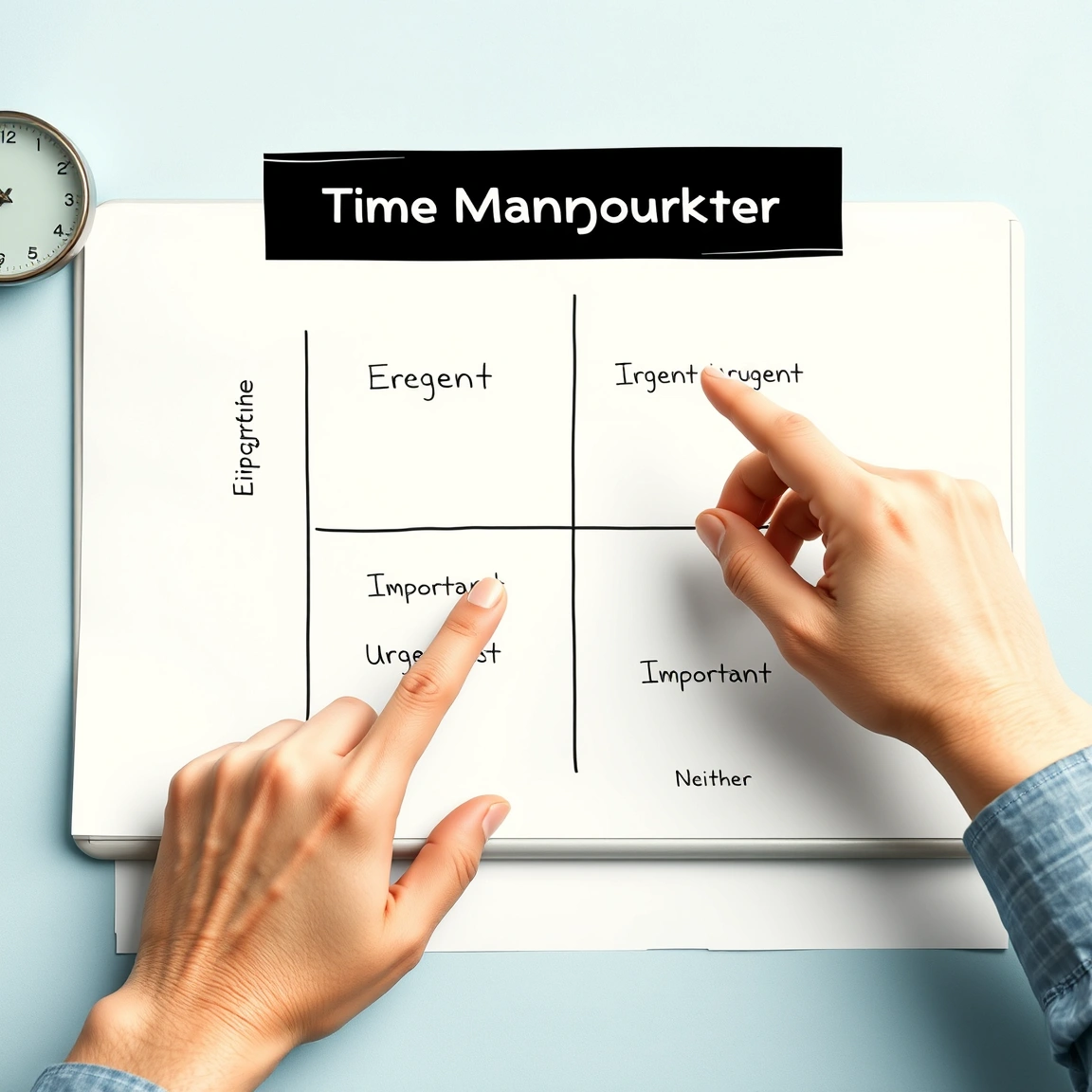
The fix is a sorting step, not a mood. The Eisenhower matrix splits every task on the list into four quadrants by urgency and importance, and assigns each quadrant a different action rather than a different priority label:
| Quadrant | Description | Action |
|---|---|---|
| Urgent + important | Deadline today, directly tied to a goal | Do it now |
| Important, not urgent | No deadline pressure, but moves a real goal | Schedule it for a specific block |
| Urgent, not important | Pressing but doesn't advance your goals | Delegate it |
| Neither | No deadline, no goal attached | Drop it |
Atlassian's breakdown of the matrix frames the second quadrant as the one that gets skipped most often — the important-but-not-urgent work like planning, skill-building or relationship maintenance, which never has a deadline forcing it onto today's list, so it keeps losing to whatever is merely loud. Running this sort on today's list, rather than treating "prioritise" as a vague instruction, is the concrete difference between this technique and just feeling stressed about the list's length.
The matrix doesn't tell you how to do the important-urgent work once it's identified — that's a sequencing and execution problem, which is what the next two techniques solve.
A large, unpleasant or ambiguous task is avoided
A task rolls forward on the list day after day not because the reader is lazy, but because it's too big or too vague to start. "Rewrite the proposal" or "deal with the vendor contract" has no obvious first move, so it's easier to answer three quick emails instead — and the anxiety about the undone task grows with every day it's deferred.
Two moves address this, in order:
- Break the task into steps small enough that each one has an obvious starting action — not "rewrite the proposal" but "draft the pricing section."
- Schedule the first step as the day's hardest task, and do it before meetings, messages or anything else gets a claim on your attention.
That second step is the core of what's commonly called "eating the frog" — doing the least appealing but highest-value task of the day first, while willpower and attention are at their peak, rather than saving it for the end when it competes with fatigue and a full inbox. Clockify's rundown of the technique describes it in exactly this order-of-operations sense: the value isn't in suffering through something unpleasant, it's in not letting a task that matters get pushed out by tasks that are merely easy.
The reframe worth keeping is that procrastination here isn't a character flaw to fix with more discipline — it's usually a task-sizing problem (the step is too big to start) combined with a sequencing problem (the step is scheduled too late in the day to survive contact with everything else competing for attention). Fixing the size and the slot fixes the avoidance far more reliably than resolving to "just do it."
Constant notifications, meetings and task switching

Deep, sustained focus doesn't survive a calendar full of meetings and a notification tray that never empties — and the cost isn't just the interruption itself, but the time spent re-orienting after each one, which is why heavily fragmented days produce fewer finished tasks than the hours worked would suggest.
Two techniques address two different parts of this problem, and they're meant to stack rather than compete.
Time blocking claims the calendar itself. Instead of an open afternoon that meetings and messages will fill by default, specific hours are assigned to specific tasks in advance, and — critically — that block is treated as an appointment other people can't casually override. Atlassian describes this as protecting attention the same way a meeting protects a room: once a slot exists on the calendar, it stops being negotiable in the way an unscheduled intention is.
The Pomodoro technique governs what happens inside that block. Work runs in a fixed interval — commonly 25 minutes — followed by a short break, with a longer break after several intervals, a structure devised by Francesco Cirillo and now documented widely as one of the most-cited interval methods for sustained focus, per the overview on Wikipedia's time management entry. The break isn't slack in the system; it's the part that keeps a full day of blocks from running into fatigue and quietly declining output toward the end of the week. Skipping the breaks to "push through" tends to produce the opposite of the intended effect — slower, sloppier work in the later intervals rather than more of it.
Used together: the block decides when the task happens and defends the time on the calendar; the Pomodoro interval decides how the work inside that block is paced. One without the other still leaves a gap — a protected block with no internal pacing tends to dissolve into the same drift-and-check-the-phone pattern it was meant to prevent.
No idea where the hours actually go
Most task-list advice assumes the reader already knows how long things take, and that assumption is usually wrong. A task estimated at thirty minutes that actually takes ninety doesn't just run late — it pushes every other item scheduled that day into the next one, and the schedule stops meaning anything.
Time tracking closes that gap by recording what actually happened against what was planned, for long enough to see a pattern — a few days of interrupted, atypical work won't show it. The University of Georgia's extension guidance on time management recommends logging how time is actually spent as a starting step precisely because most people misjudge which activities are consuming the bulk of their day, and a log corrects the estimate before a schedule is built on top of it.
Once the log exists, it usually points to one of three fixes rather than a vague resolve to "manage time better":
- Batch similar small tasks (email, approvals, status updates) into one block instead of letting them interrupt task-focused time throughout the day.
- Cut or shorten recurring meetings that the log shows consuming hours without a proportional output.
- Delegate tasks the log reveals you're doing but don't need to be the one doing.
The payoff isn't just a tidier calendar — it's that future estimates and deadlines start holding, because they're built from measured task duration instead of guesswork. Two weeks of tracking is usually the minimum needed to tell whether a technique adopted afterward — a time block, a Pomodoro schedule, a reordered list — is actually changing the gap between planned and actual time, rather than just feeling more organized.
Time management, and why the lists don't agree on a number
Time management is the practice of planning and controlling how time is allocated across tasks and goals, rather than letting the day's order be set by whichever task arrives loudest — Wikipedia's overview traces the term through decades of shifting emphasis, from rigid scheduling systems toward approaches that weigh attention and energy alongside the clock. The techniques above are five different tools within that practice, not competing definitions of it.
The "5 techniques," "9 tools," "10 strategies" and "58 methods" that show up in searches for this topic aren't disagreeing about what works so much as counting at different levels of granularity. A short list names the layers — prioritize, plan, execute, track — and a long one lists every specific tactic that fits inside each layer. The techniques that appear on nearly every list, short or long, are the same four covered above: the Eisenhower matrix for deciding what matters, eating the frog for sequencing the hardest item first, time blocking for placing work on the calendar, and the Pomodoro technique for pacing execution once you're in the block. A fifth that shows up almost as consistently is keeping a running to-do list at all — not as a technique in itself, but as the raw material the other four operate on.
Two shorter formulas come up often enough to be worth naming directly, and they're best answered plainly rather than padded:
- The "five P's of time management" — usually rendered as some variant of Prior Planning Prevents Poor Performance — is a training mnemonic, not a tested model. It's worth knowing as a phrase you might hear in a meeting, but it doesn't carry the kind of evidence behind, for instance, the Eisenhower matrix's decision structure.
- The "3-3-3 rule" is an informal way of shaping a single workday: roughly three hours on one demanding task, a handful of shorter tasks, and a short block for maintenance work like email or tidying. The exact split varies across descriptions, and it functions less as a validated method than as a rough day-structuring habit — useful as a starting template, not a rule with research behind it.
Where a technique does have a documented source — Cirillo's Pomodoro structure, the Eisenhower quadrant framing — it's worth treating with more confidence than a mnemonic invented for a training slide. Both can still be useful, but they're not the same category of claim.
Prioritization: matching the technique to the kind of work
Prioritization is the act of deciding which tasks matter most, and the honest answer to "which technique should I use" depends on whether the reader's day is reactive or project-based — a distinction most technique roundups skip entirely.
For reactive, interrupt-driven work — support roles, anything where requests arrive unpredictably through the day — the Eisenhower matrix earns its keep because its whole purpose is triage: deciding in the moment whether an incoming item is a do-now, a schedule-later, a delegate, or a drop. Time blocking is harder to sustain here, because blocks get overwritten by the interruptions the role exists to handle; a looser structure, like protecting one or two short blocks a day rather than the whole calendar, tends to survive better.
For project-based work with fewer unpredictable interruptions, time blocking and the Pomodoro technique do more of the work, because the goal is protecting long stretches for a known task rather than triaging an unpredictable stream. Eating the frog fits naturally here too, since project tasks are more often the kind that get avoided for being large or unpleasant rather than urgent.
Solo versus team roles changes which technique is even available to run. Someone who controls their own calendar can block it freely; someone whose calendar is largely set by other people's meetings has to apply these methods at the margins — claiming the 30 minutes before the first meeting for the day's frog, or using a tracked log to build a case for cutting a recurring meeting rather than assuming they can simply decline it. Time management technique lists rarely say this out loud, but the technique that's "best" changes with how much control over the calendar the reader actually has, not just with the shape of the task list.
When a technique isn't the right fix
Not every version of "the list keeps growing" is solved by a better technique. If the list grows faster than it clears despite consistent time blocking and tracking, the underlying issue is usually volume or staffing, not sequencing — no amount of quadrant-sorting fixes a workload that's genuinely larger than the hours available. If priorities are set by someone else and change without warning, the Eisenhower matrix still works for today's list, but it can't fix a structural problem where "important" keeps being redefined upstream; that's a conversation with whoever is assigning the work, not a personal scheduling fix.
Time blocks also fail in a specific, predictable way: an interruption breaks the block, and the instinct is to abandon the plan for the day. A steadier response is to note where the interruption happened, finish or reschedule the remainder of that block, and let the rest of the day's blocks continue as planned — one broken block doesn't need to cost the other three. The University of Georgia's extension guidance treats re-planning after a disruption as a normal part of the practice rather than evidence that the system has failed.
Start smaller than a full overhaul: track actual time spent for a few days, sort tomorrow's list through the matrix once, and put one frog on the calendar before the first meeting. Whether it's working shows up in the log two weeks out — not in how organized today felt.