
New or remote members have few shared touchpoints

A new hire, a team formed by a merger, or a group that added three remote contractors in the same quarter all share one problem: nobody has enough context on anyone else to know what to ask. That absence shows up fast as thin communication — people default to formal, task-only exchanges because they have no informal thread to pull on, and work starts happening in silos because nobody thinks to loop in someone they don't know well.
The fix that costs nothing and needs no venue is a short icebreaker or five-minute activity dropped into a meeting that's already on the calendar. Bryant University's compiled list of five-minute team-building exercises frames these as warm-ups that fit inside an existing agenda rather than activities that need their own booking — a two-minute round of "one thing you're working on that nobody here knows about" or a rapid-fire this-or-that question set does the job without asking anyone to find an extra half hour (Bryant University).
Run one of these at the start of a recurring meeting for a few weeks and the effect to watch for isn't enthusiasm — it's whether people start volunteering information unprompted later in the same meeting. That's the actual signal that thin communication is loosening, not whether the icebreaker itself was popular.
- Costs nothing: no facilitator fee, no room booking, no software beyond what the meeting already uses
- Takes under five minutes, so it survives a packed agenda
- Works identically in person or on a call, which matters for mixed teams
Team struggles to solve problems jointly under pressure

Duplicated effort and decisions that stall in committee are the tell that a team isn't solving problems jointly — people are working the same problem in parallel instead of dividing it, or nobody is willing to make a call without everyone else's sign-off. This is a different failure than low familiarity, and it needs a different kind of exercise: something with a real time constraint and a single measurable outcome.
A timed problem-solving challenge — an escape-room-style puzzle, a build challenge with a materials cap, or a structured case exercise — puts the team under exactly the kind of pressure that exposes how they actually divide labour and make decisions, as opposed to how they say they do. Asana's roundup of team-building games groups these under problem-solving specifically because the constraint (a clock, a limited resource) is what forces the behaviour you're trying to observe or change (Asana).
The exercise itself doesn't transfer anything to real work unless it's debriefed. A short set of questions immediately afterward is what turns a puzzle into a communication or planning skill:
- Where did we lose time, and was it a communication gap or a decision-making one?
- Who ended up making the calls, and was that by default or by design?
- What's one thing from how we worked just now that we'd use on [a named current project]?
Skip the debrief and the activity is remembered as a game. Run it and name the parallel to a live project, and it's the closest thing to transferable practice a thirty-minute session can offer.
Distributed team has no shared room
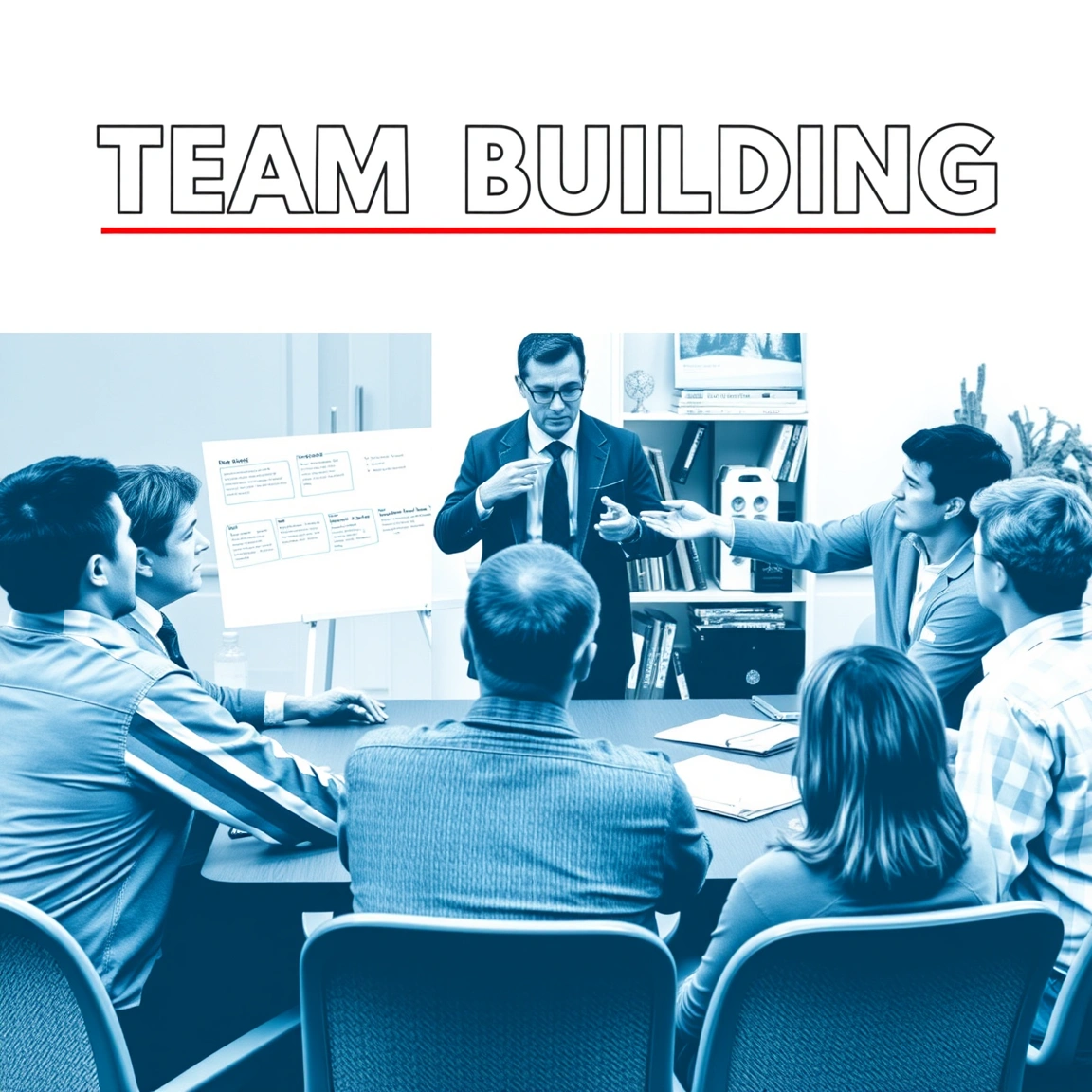
A team split across time zones or home offices can't run anything that assumes shared physical space — no whiteboard walk, no object passed hand to hand, no room to split into corners. The fix isn't to drop team building; it's to substitute formats built for video call from the start rather than adapting an in-person game and hoping it survives the translation.
Call fatigue is the other constraint remote sessions run into that in-person ones don't: a group that's already spent the day on video calls will disengage from anything that runs long, regardless of how good the exercise is. HR Morning's guidance on small-team activities makes the same point about scale that applies doubly to remote sessions — an exercise that works for a room of twenty often breaks down entirely at a headcount of four or five, because there's no critical mass to split into sub-groups or keep momentum going if one or two people go quiet (HR Morning).
| Format | Group size | Time | Works remote |
|---|---|---|---|
| Icebreaker question round | Any | 5 min | Yes — works well on call |
| Shared-screen puzzle or trivia | 4–15 | 10–20 min | Yes, with one screen-share host |
| Escape-room-style challenge | 4–10 | 30–60 min | Partial — needs a remote-specific vendor |
| Physical build challenge | 6–20 | 20–30 min | No — needs shared materials in a room |
For a distributed team, the practical filter is simple: if the exercise depends on shared physical objects or overhearing side conversations in a room, it needs a remote-native substitute rather than a video-call adaptation.
Activity is chosen for fun alone and imposed on the team
An activity picked because a manager thought it looked fun, then scheduled without asking whether it fits the team's actual problem, reads to participants as forced fun — and forced fun is one of the more reliable ways to damage trust rather than build it. The tell is disengagement during the activity itself: people going through the motions, checking phones, or opting out quietly if they can.
The corrective isn't more enthusiasm from the organiser, it's matching the choice to three concrete inputs — team size, the time actually available, and a named problem the team is trying to fix — and then debriefing it against that problem afterward. IMD's guidance on team-building activities makes this the hinge point: an activity chosen to address a stated goal reads as work the team is doing together, while the same activity chosen just to fill a slot on an offsite agenda reads as something being done to them (IMD).
Participation should be framed as tied to a work outcome, not attendance for its own sake. A short opening line that states what the activity is meant to fix — "we're doing this because our last retro flagged that decisions stall in meetings" — does more to make participation feel voluntary in spirit than any amount of enthusiasm from the facilitator.
What are the five C's of team building?
The "five C's" that circulate in team-building material — most commonly Communication, Collaboration, Commitment, Camaraderie, and Conflict resolution — is a practitioner mnemonic used in consulting and trade-book material to describe the traits a well-functioning team is supposed to display. It is not a peer-reviewed model with a named study behind it, and different versions of the list swap in words like Cohesion or Clarity depending on who's presenting it. Treat it the way you'd treat any consultant's checklist: useful as a set of headings to structure a conversation, not as a validated instrument for measuring team health.
For a manager, the practical use of the five C's is as a diagnostic lens rather than a scorecard:
- Communication — is information actually flowing, or just being reported up a chain?
- Collaboration — are people doing joint work, or dividing it and reassembling it at the end?
- Commitment — do people follow through on what they agreed to in the room?
- Camaraderie — is there any informal contact outside task-related exchange?
- Conflict resolution — does disagreement get worked through, or avoided until it stalls a decision?
If a team is weak on Communication and Camaraderie, a short icebreaker addresses the gap directly. If the weak point is Conflict resolution or Commitment, an icebreaker won't touch it — that's a process or a management conversation, not a thirty-minute activity, and running a game instead of having that conversation just delays it.
Icebreaker, team-building exercise, or social event — which one do you actually need?
These three get used interchangeably but they fix different problems, and picking the wrong one wastes the slot. An icebreaker builds familiarity — it's for people who don't know each other yet. A team-building exercise practises a skill, usually communication or joint problem-solving, under a constraint that mimics real work pressure. A social event builds morale and goodwill with no built-in skill component at all.
The confusion causes real waste: running a trivia night to fix a team that can't make decisions together does nothing for decision-making, because trivia has no structural connection to how the team divides work. Conversely, running a high-pressure problem-solving challenge for a group that just needs to get comfortable talking to each other can backfire — it adds performance pressure before there's enough trust to handle it.
| Type | Fixes | Typical length | Needs a debrief? |
|---|---|---|---|
| Icebreaker | Unfamiliarity, thin communication | 5 min | Optional |
| Team-building exercise | Weak collaboration, poor joint decision-making | 20–60 min | Yes, always |
| Social event | Low morale, no informal contact | 1 hour+ | No |
Naming which of the three you're running, out loud, before you run it, is the single cheapest way to avoid the mismatch — it forces the choice to be about the problem rather than the calendar slot.
Choosing an activity when you have thirty minutes or less
The decision rule is the same regardless of which activity list you're looking at: start from the constraint, not the activity name. Four inputs settle it in under two minutes.
- How many people are in the room? Under six, most icebreaker formats and short problem-solving challenges work as-is. Past about fifteen, split into sub-groups or the quieter members disappear entirely.
- How much time is actually available? If it's five minutes inside an existing meeting, only an icebreaker question or rapid prompt fits — anything with setup instructions eats the whole slot before it starts.
- Is everyone in the same room? If not, cut anything that depends on shared physical materials or line-of-sight cues and default to a screen-shared or verbal-only format.
- What's the actual problem? Thin familiarity needs an icebreaker. Weak joint problem-solving needs a timed challenge with a debrief. Low morale on an otherwise functional team needs a social event, not an exercise — running a "trust exercise" on a team that already trusts each other just burns a slot.
Slack's collection of team-building ideas makes a similar point about scale to the one above: an activity that's described as good "for any team size" almost never survives contact with a group of forty, because the format that keeps eight people engaged (everyone gets a turn, everyone is seen) stops working once turns take too long to cycle through (Slack). If the group is large, plan to split it before the session starts rather than trying to run one activity across the whole room.
Opt-out, inclusion, and whether participation should be mandatory
Not everyone can or should be required to take part in every format, and treating participation as mandatory by default is where a lot of otherwise reasonable activities go wrong. Physical challenges exclude people with mobility limitations. Food-based icebreakers ("bring something that represents your culture") can put dietary or religious constraints on display in ways some participants would rather not have surfaced. And activities built around rapid, public self-disclosure are genuinely harder for introverted team members, not because they're being difficult but because the format itself rewards a specific communication style.
The practical fix is to build an opt-out path into the activity's design rather than treating it as an exception to grant on request:
- Offer a written or async alternative for verbal-disclosure icebreakers, so someone can contribute without speaking first in a group
- Avoid food-based or physical-contact formats as the default when the team's roster or accommodation needs aren't known
- State explicitly that watching counts as participating — nobody should have to justify sitting a round out
Mandatory attendance at work-hours activities is a different question from mandatory participation once there. For activities held outside scheduled hours, the voluntariness of attendance and the wage-and-hour status of non-exempt staff are legal questions, not just culture ones, and they vary by jurisdiction — that's worth checking with HR or legal counsel before scheduling anything off the clock, rather than assuming a fun-sounding event is exempt from the usual rules.
Whether it worked
The only honest way to know if an activity changed anything is to check the same symptom that prompted it, not to ask whether people enjoyed the session. If the original problem was that only three people spoke in meetings, the test three weeks later is whether more than three people speak — not a satisfaction score collected right after the activity ended, when everyone is primed to say it was fine.
Pick one measurable behaviour before you run the activity, not after: number of people who speak unprompted in the next status meeting, number of cross-team messages sent in the following week, or whether a decision that used to require the full group now gets made by a smaller subset without stalling. Afterburner's material on team-building outcomes makes the point that the activity itself is rarely what changes behaviour — the follow-through afterward, tying what happened in the exercise back to a specific piece of ongoing work, is what makes the difference stick (Afterburner).
Set that one measure before the meeting invite goes out, check it against the same meeting a few weeks later, and you'll know a great deal more than any post-activity survey would have told you.